
A new class of supply-chain malware can self-propagate across software ecosystems and not just compromise a single package. The Shai-Hulud worm combines credential theft with automated package infection and republishing capabilities to create an extremely dangerous threat.
This new malware reflects a shift from targeted supply-chain compromises to a scalable threat that has the ability to automatically spread through dependency chains. The risk extends into cloud services and CI/CD pipelines because of credential harvesting. Risk reduction depends on securing developer workflows, limiting credential exposure and improving pipeline visibility.
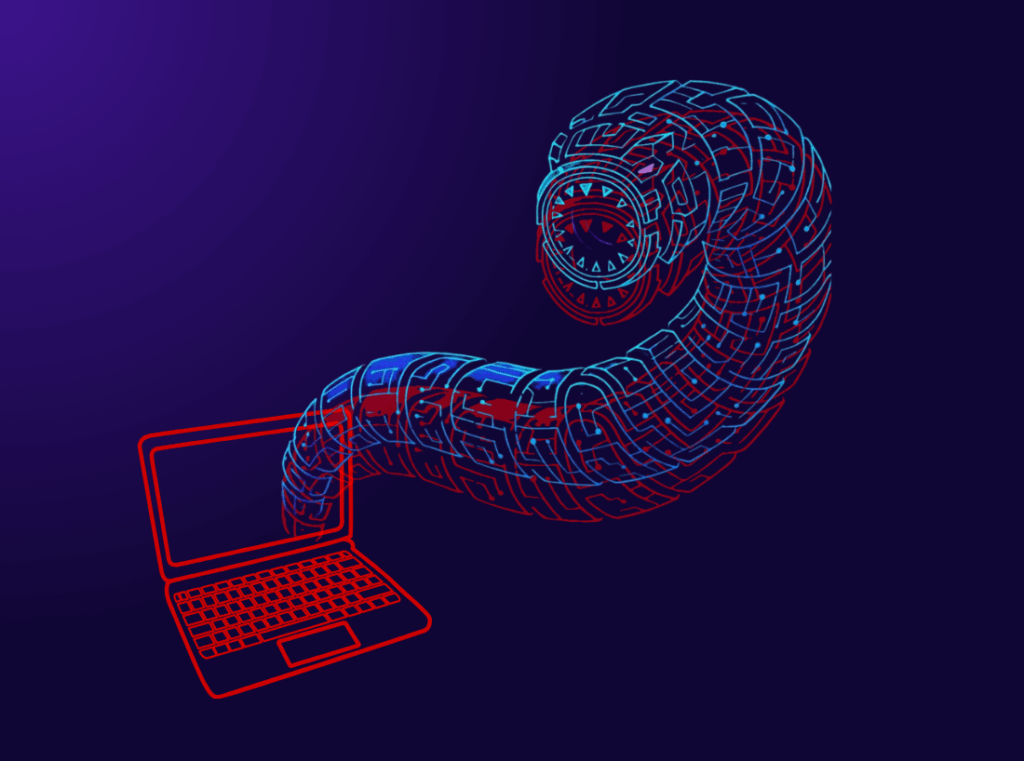
A shift in how supply-chain attacks work
For years, most supply-chain attacks depended on a single point of compromise. An attacker would gain access to a vendor or library and insert malicious code into a trusted update. From there, the attack would spread only as far as that distribution channel allowed. Now, that model has changed. Emerging threats like Shai-Hulud show how attackers are moving toward self-propagating supply-chain attacks that spread through developer ecosystems without continuous attacker control. Instead of maintaining access to one source, this new malware turns each newly compromised environment into another distribution point.
What the Shai-Hulud worm actually does
The Shai-Hulud malware takes advantage of the automated, implicit trust placed in open-source software and Continuous Integration and Continuous Delivery (CI/CD) pipelines.
Initial Compromise: Attackers hijack legitimate developer accounts or inject payloads into trusted, widely used open-source dependencies.
Execution: The worm automatically executes malicious code (often hidden via obfuscated pre-install or post-install scripts) when the compromised package is downloaded or built.
Credential Harvesting: It scans the developer’s environment (including memory and disk paths) for sensitive keys, tokens, and cloud credentials (AWS, Azure, GCP).
Self-Propagation: Using the stolen credentials, the worm automatically infects other software packages maintained by the compromised developer and republishes them to the NPM (Node Package Manager) registry.
Using those steps, the Shai-Hulud has very successfully compromised the developer ecosystems such as npm, PyPI, GitHub, and Continuous Integration and Continuous Delivery (CI/CD) pipelines. Recently these prominent packages have been breached by Shai-Hulud:
@antv Ecosystem: In June 2026, a massive campaign compromised over 300 packages in the popular JavaScript data-visualization namespace (e.g., charting and graphing libraries).
TanStack & Mistral AI: In May 2026, malicious versions were published across 42 packages within the @tanstack namespace, subsequently spreading to developers at Mistral AI and UiPath.
Red Hat Cloud Services: In June 2026, dozens of official packages inside the @redhat-cloud-services namespace were republished with the malware.
Core & Utility Libraries: Earlier waves of the worm compromised widely used foundational packages, most notably @ctrl/tinycolor (which handles millions of downloads).
Enterprise & Bot Services: High-profile developer and automation tools—including packages from Postman, PostHog, Zapier, and ENS Domains—were hijacked and briefly trojanized.
SAP CAP: The worm targeted npm packages relied upon by SAP’s Cloud Application Programming Model.
PyTorch Lightning & Bitwarden CLI: Several major PyPI packages and CLI tools have also fallen victim to cross-ecosystem variants
The risks this creates for organizations.
It is a rapid and low friction spread. The malware executes during normal package installation, without requiring phishing or user action. This reduces opportunities for detection through traditional user-focused controls.
It is a credential-driven compromise. The primary objective is to capture credentials tied to development and infrastructure systems. Once obtained, these credentials allow attackers to move beyond the original system.
The exposure exists beyond endpoints. Because modern development workflows connect directly to cloud platforms and deployment systems, a single infected package can provide a path into Continuous Integration and Continuous Delivery (CI/CD) pipelines and cloud environments such as Amazon and Azure.
Trusted platform abuse. The malware uses legitimate services such as GitHub and NPM to store or transmit stolen data, which makes malicious behavior harder to distinguish from normal workflows.
Variable downstream impact. While credential theft and propagation are consistent, some variants may introduce additional behavior, including destructive or secondary payloads.
How to reduce risk from worm-like supply-chain attacks
An investment must be made to secure developer environments. Developer workstations and build systems are central to this attack model. Protecting and monitoring them should be treated as a priority. Developers need more security and more security controls now than ever.
Tighten credential management. Limiting what credentials can access reduces propagation potential:
Use short-lived tokens
Apply least-privilege access
Rotate credentials regularly
Strengthen dependency controls
To reduce exposure at the package level:
Review new and updated dependencies before use
Monitor for unexpected changes or unusual publishing activity
Restrict package publishing rights where possible
Improve visibility across the pipeline
Understanding how code moves through your environment helps you detect anomalies:
Track dependency usage and updates
Monitor repository and Continuous Integration and Continuous Delivery (CI/CD) activity
Identify unexpected changes in package ownership or behavior
Prepare for broader incident response
If this type of malware is detected, it should be treated as more than a single infected package. A full response may include credential rotation, repository audits and infrastructure review. For smaller teams, the challenge is balancing speed and security. Modern development depends heavily on open-source components and automated workflows, which dramatically increases exposure to supply-chain risks.